

How To Draw A Circle Usind Sin Function
To define our trigonometric functions, we brainstorm by drawing a unit circumvolve, a circle centered at the origin with radius ane, as shown in Figure 2. The angle (in radians) that [latex]t[/latex] intercepts forms an arc of length [latex]s[/latex]. Using the formula [latex]south=rt[/latex], and knowing that [latex]r=1[/latex], we see that for a unit circumvolve, [latex]s=t[/latex].
Think that the x- and y-axes divide the coordinate aeroplane into four quarters called quadrants. We label these quadrants to mimic the direction a positive bending would sweep. The four quadrants are labeled I, 2, III, and Iv.
For whatever angle [latex]t[/latex], we can label the intersection of the terminal side and the unit circle equally past its coordinates, [latex]\left(x,y\correct)[/latex]. The coordinates [latex]x[/latex] and [latex]y[/latex] will be the outputs of the trigonometric functions [latex]f\left(t\correct)=\cos t[/latex] and [latex]f\left(t\right)=\sin t[/latex], respectively. This means [latex]x=\cos t[/latex] and [latex]y=\sin t[/latex].
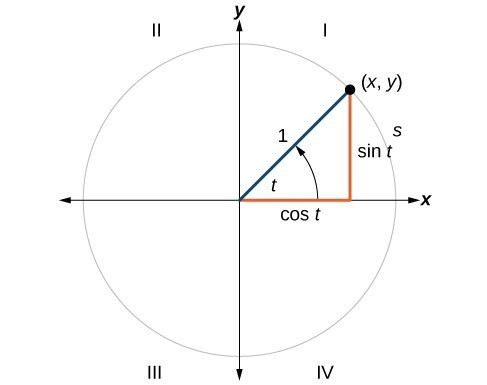
Effigy 2. Unit circle where the cardinal bending is [latex]t[/latex] radians
A General Notation: Unit Circle
A unit circle has a heart at [latex]\left(0,0\right)[/latex] and radius [latex]i[/latex] . In a unit circle, the length of the intercepted arc is equal to the radian measure out of the central bending [latex]1[/latex].
Allow [latex]\left(10,y\right)[/latex] be the endpoint on the unit of measurement circle of an arc of arc length [latex]due south[/latex]. The [latex]\left(x,y\right)[/latex] coordinates of this signal tin can exist described as functions of the angle.
Defining Sine and Cosine Functions
Now that we have our unit circle labeled, we can learn how the [latex]\left(ten,y\right)[/latex] coordinates relate to the arc length and angle. The sine function relates a real number [latex]t[/latex] to the y-coordinate of the point where the corresponding bending intercepts the unit circumvolve. More precisely, the sine of an angle [latex]t[/latex] equals the y-value of the endpoint on the unit circle of an arc of length [latex]t[/latex]. In Figure 2, the sine is equal to [latex]y[/latex]. Similar all functions, the sine function has an input and an output. Its input is the measure of the bending; its output is the y-coordinate of the corresponding point on the unit of measurement circle.
The cosine function of an bending [latex]t[/latex] equals the x-value of the endpoint on the unit circle of an arc of length [latex]t[/latex]. In Figure 3, the cosine is equal to [latex]x[/latex].
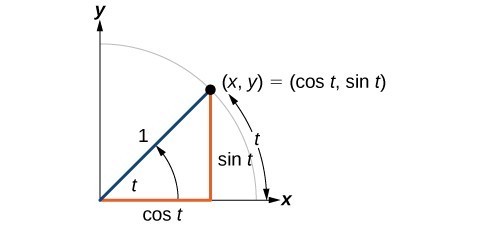
Figure 3
Because it is understood that sine and cosine are functions, we do non always need to write them with parentheses: [latex]\sin t[/latex] is the same as [latex]\sin \left(t\right)[/latex] and [latex]\cos t[/latex] is the same every bit [latex]\cos \left(t\right)[/latex]. Also, [latex]{\cos }^{2}t[/latex] is a commonly used autograph notation for [latex]{\left(\cos \left(t\right)\correct)}^{2}[/latex]. Be aware that many calculators and computers do not recognize the autograph note. When in dubiety, use the extra parentheses when entering calculations into a calculator or reckoner.
A General Note: Sine and Cosine Functions
If [latex]t[/latex] is a existent number and a point [latex]\left(10,y\correct)[/latex] on the unit circle corresponds to an angle of [latex]t[/latex], then
[latex]\cos t=ten[/latex]
[latex]\sin t=y[/latex]
How To: Given a point P [latex]\left(x,y\right)[/latex] on the unit circumvolve respective to an angle of [latex]t[/latex], find the sine and cosine.
- The sine of [latex]t[/latex] is equal to the y-coordinate of indicate [latex]P:\sin t=y[/latex].
- The cosine of [latex]t[/latex] is equal to the x-coordinate of signal [latex]P: \text{cos}t=ten[/latex].
Case 1: Finding Function Values for Sine and Cosine
Point [latex]P[/latex] is a point on the unit circle corresponding to an angle of [latex]t[/latex], as shown in Effigy iv. Find [latex]\cos \left(t\correct)\\[/latex] and [latex]\text{sin}\left(t\right)\\[/latex].
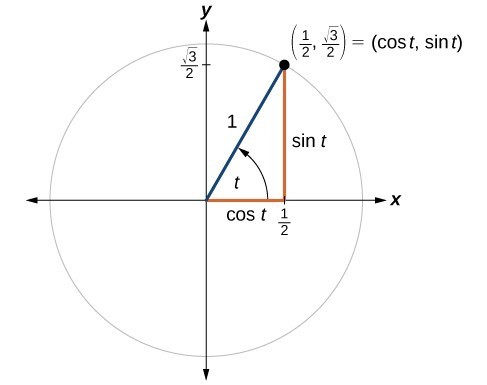
Effigy 4
Solution
We know that [latex]\cos t[/latex] is the ten-coordinate of the corresponding point on the unit circle and [latex]\sin t[/latex] is the y-coordinate of the corresponding point on the unit circle. So:
[latex]\begin{array}{l}\brainstorm{array}{l}\\ 10=\cos t=\frac{1}{2}\end{array}\hfill \\ y=\sin t=\frac{\sqrt{3}}{ii}\hfill \end{assortment}\\[/latex]
Endeavor It 1
A sure angle [latex]t[/latex] corresponds to a point on the unit of measurement circumvolve at [latex]\left(-\frac{\sqrt{2}}{2},\frac{\sqrt{two}}{ii}\correct)\\[/latex] as shown in Figure 5. Find [latex]\cos t[/latex] and [latex]\sin t[/latex].
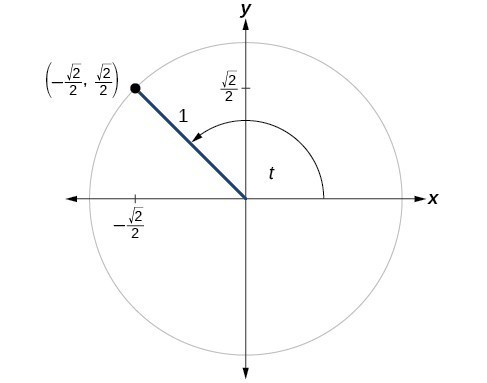
Figure v
Solution
Finding Sines and Cosines of Angles on an Axis
For quadrantral angles, the corresponding indicate on the unit circle falls on the 10- or y-axis. In that case, we can hands calculate cosine and sine from the values of [latex]x[/latex] and [latex]y[/latex].
Example 2: Calculating Sines and Cosines along an Axis
Detect [latex]\cos \left(xc^\circ \right)\\[/latex] and [latex]\text{sin}\left(90^\circ \right)\\[/latex].
Solution
Moving [latex]90^\circ [/latex] counterclockwise around the unit of measurement circle from the positive x-axis brings us to the tiptop of the circle, where the [latex]\left(x,y\correct)[/latex] coordinates are (0, 1), equally shown in Figure 6.
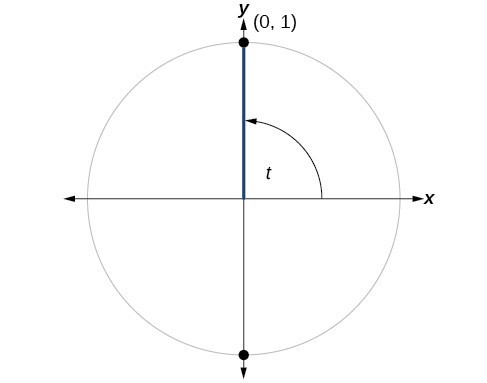
Figure half dozen
Using our definitions of cosine and sine,
[latex]\begin{array}{fifty}x=\cos t=\cos \left(90^\circ \right)=0\\ y=\sin t=\sin \left(90^\circ \right)=1\end{array}\\[/latex]
The cosine of 90° is 0; the sine of 90° is i.
Endeavor It 2
Find cosine and sine of the angle [latex]\pi [/latex].
Solution
The Pythagorean Identity
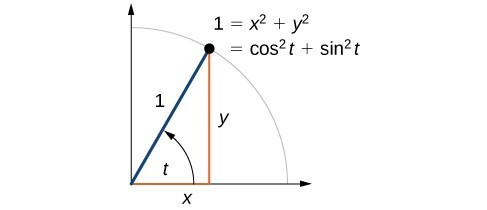
Figure 7
At present that nosotros can define sine and cosine, nosotros volition acquire how they relate to each other and the unit circumvolve. Recall that the equation for the unit circumvolve is [latex]{10}^{two}+{y}^{2}=1[/latex]. Because [latex]x=\cos t[/latex] and [latex]y=\sin t[/latex], nosotros can substitute for [latex]x[/latex] and [latex]y[/latex] to get [latex]{\cos }^{ii}t+{\sin }^{2}t=1[/latex]. This equation, [latex]{\cos }^{2}t+{\sin }^{2}t=1[/latex], is known equally the Pythagorean Identity.
Nosotros can use the Pythagorean Identity to find the cosine of an angle if we know the sine, or vice versa. However, considering the equation yields two solutions, we need additional cognition of the angle to choose the solution with the correct sign. If nosotros know the quadrant where the bending is, we can easily choose the correct solution.
A General Notation: Pythagorean Identity
The Pythagorean Identity states that, for any real number [latex]t[/latex],
[latex]{\cos }^{two}t+{\sin }^{ii}t=1[/latex]
How To: Given the sine of some angle [latex]t[/latex] and its quadrant location, find the cosine of [latex]t[/latex].
- Substitute the known value of [latex]\sin \left(t\right)[/latex] into the Pythagorean Identity.
- Solve for [latex]\cos \left(t\right)[/latex].
- Choose the solution with the appropriate sign for the 10-values in the quadrant where [latex]t[/latex] is located.
Example 3: Finding a Cosine from a Sine or a Sine from a Cosine
If [latex]\sin \left(t\right)=\frac{3}{7}\\[/latex] and [latex]t[/latex] is in the second quadrant, discover [latex]\cos \left(t\correct)\\[/latex].
Solution
If we drop a vertical line from the point on the unit of measurement circumvolve respective to [latex]t[/latex], we create a right triangle, from which we can come across that the Pythagorean Identity is just i case of the Pythagorean Theorem.
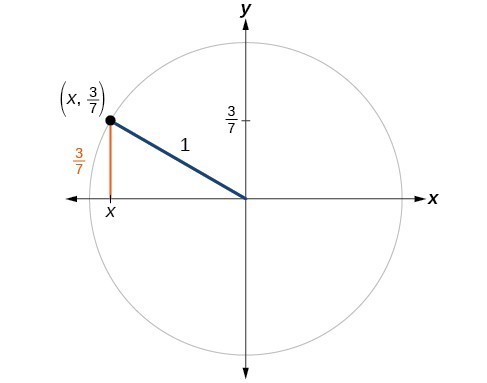
Figure 8
Substituting the known value for sine into the Pythagorean Identity,
[latex]\begin{array}{l}{\cos }^{2}\left(t\right)+{\sin }^{two}\left(t\right)=ane\hfill \\ {\cos }^{ii}\left(t\correct)+\frac{ix}{49}=1\hfill \\ {\cos }^{2}\left(t\right)=\frac{forty}{49}\hfill \\ \text{cos}\left(t\right)=\pm \sqrt{\frac{40}{49}}=\pm \frac{\sqrt{forty}}{7}=\pm \frac{2\sqrt{10}}{vii}\hfill \end{array}\\[/latex]
Because the angle is in the second quadrant, we know the x-value is a negative existent number, and so the cosine is also negative. And so
[latex]\text{cos}\left(t\correct)=-\frac{2\sqrt{x}}{7}\\[/latex]
Try It 3
If [latex]\cos \left(t\right)=\frac{24}{25}\\[/latex] and [latex]t[/latex] is in the fourth quadrant, find [latex]\text{sin}\left(t\right)\\[/latex].
Solution
Finding Sines and Cosines of Special Angles
We have already learned some properties of the special angles, such as the conversion from radians to degrees. We can also summate sines and cosines of the special angles using the Pythagorean Identity and our knowledge of triangles.
Finding Sines and Cosines of 45° Angles
Start, we will wait at angles of [latex]45^\circ [/latex] or [latex]\frac{\pi }{4}[/latex], equally shown in Figure ix. A [latex]45^\circ -45^\circ -xc^\circ [/latex] triangle is an isosceles triangle, so the x- and y-coordinates of the corresponding point on the circle are the same. Considering the x- and y-values are the same, the sine and cosine values will also be equal.
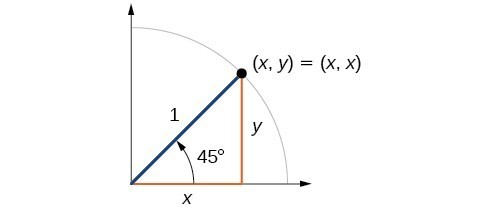
Figure 9
At [latex]t=\frac{\pi }{4}[/latex] , which is 45 degrees, the radius of the unit circumvolve bisects the offset quadrantal angle. This means the radius lies forth the line [latex]y=x[/latex]. A unit of measurement circumvolve has a radius equal to 1. So, the right triangle formed below the line [latex]y=10[/latex] has sides [latex]x[/latex] and [latex]y\text{ }\left(y=x\right)[/latex], and a radius = 1.
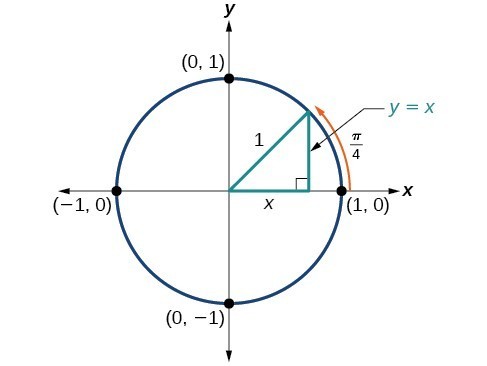
Effigy 10
From the Pythagorean Theorem we get
[latex]{x}^{2}+{y}^{ii}=i[/latex]
Substituting [latex]y=x[/latex], nosotros get
[latex]{10}^{2}+{x}^{2}=one[/latex]
Combining like terms we get
[latex]two{x}^{ii}=1[/latex]
And solving for [latex]x[/latex], nosotros get
[latex]\begin{array}{c}{x}^{two}=\frac{one}{2}\\ \text{ }ten=\pm \frac{1}{\sqrt{ii}}\end{array}\\[/latex]
In quadrant I, [latex]x=\frac{ane}{\sqrt{2}}\\[/latex].
At [latex]t=\frac{\pi }{four}[/latex] or 45 degrees,
[latex]\begin{array}{fifty}\left(10,y\correct)=\left(x,10\right)=\left(\frac{1}{\sqrt{2}},\frac{one}{\sqrt{two}}\right)\hfill \\ x=\frac{1}{\sqrt{2}},y=\frac{i}{\sqrt{two}}\hfill \\ \cos t=\frac{ane}{\sqrt{2}},\sin t=\frac{1}{\sqrt{two}}\hfill \end{array}\\[/latex]
If we then rationalize the denominators, we go
[latex]\begin{array}{fifty}\cos t=\frac{1}{\sqrt{ii}}\frac{\sqrt{2}}{\sqrt{2}}\hfill \\ =\frac{\sqrt{ii}}{ii}\hfill \\ \sin t=\frac{1}{\sqrt{two}}\frac{\sqrt{two}}{\sqrt{2}}\hfill \\ =\frac{\sqrt{2}}{2}\hfill \end{array}\\[/latex]
Therefore, the [latex]\left(x,y\right)\\[/latex] coordinates of a signal on a circle of radius [latex]ane[/latex] at an angle of [latex]45^\circ [/latex] are [latex]\left(\frac{\sqrt{2}}{ii},\frac{\sqrt{ii}}{two}\right)\\[/latex].
Finding Sines and Cosines of 30° and 60° Angles
Next, nosotros volition find the cosine and sine at an angle of [latex]30^\circ [/latex], or [latex]\frac{\pi }{6}\\[/latex] . First, we will draw a triangle inside a circumvolve with one side at an angle of [latex]30^\circ [/latex], and some other at an angle of [latex]-thirty^\circ [/latex], equally shown in Figure xi. If the resulting ii right triangles are combined into i large triangle, discover that all three angles of this larger triangle will be [latex]threescore^\circ [/latex], as shown in Figure 12.
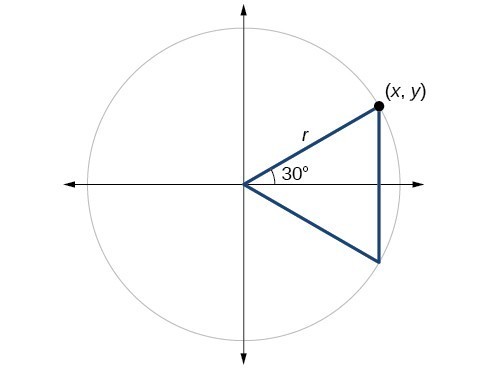
Figure 11

Figure 12
Because all the angles are equal, the sides are also equal. The vertical line has length [latex]2y[/latex], and since the sides are all equal, we can as well conclude that [latex]r=2y[/latex] or [latex]y=\frac{1}{2}r[/latex]. Since [latex]\sin t=y[/latex] ,
[latex]\sin \left(\frac{\pi }{6}\right)=\frac{i}{2}r\\[/latex]
And since [latex]r=1[/latex] in our unit of measurement circle,
[latex]\begin{array}{l}\sin \left(\frac{\pi }{6}\right)=\frac{1}{2}\left(1\right)\hfill \\ \text{ }=\frac{1}{two}\hfill \cease{array}\\[/latex]
Using the Pythagorean Identity, we can find the cosine value.
[latex]\begin{assortment}{ll}{\cos }^{ii}\frac{\pi }{6}+{\sin }^{2}\left(\frac{\pi }{vi}\right)=1\hfill & \hfill \\ \text{ }{\cos }^{2}\left(\frac{\pi }{6}\right)+{\left(\frac{i}{ii}\correct)}^{two}=1\hfill & \hfill \\ \text{ }{\cos }^{ii}\left(\frac{\pi }{six}\right)=\frac{three}{4}\hfill & \text{Apply the square root holding}.\hfill \\ \text{ }\cos \left(\frac{\pi }{6}\right)=\frac{\pm \sqrt{three}}{\pm \sqrt{4}}=\frac{\sqrt{3}}{2}\hfill & \text{Since }y\text{ is positive, cull the positive root}.\hfill \stop{assortment}\\[/latex]
The [latex]\left(10,y\right)[/latex] coordinates for the point on a circle of radius [latex]1[/latex] at an angle of [latex]xxx^\circ [/latex] are [latex]\left(\frac{\sqrt{3}}{2},\frac{i}{2}\right)\\[/latex]. At [latex]t=\frac{\pi }{three}[/latex] (60°), the radius of the unit circle, ane, serves every bit the hypotenuse of a 30-lx-90 degree right triangle, [latex]BAD[/latex], as shown in [link]. Angle [latex]A[/latex] has measure [latex]threescore^\circ [/latex]. At point [latex]B[/latex], we draw an angle [latex]ABC[/latex] with measure of [latex]60^\circ [/latex]. We know the angles in a triangle sum to [latex]180^\circ [/latex], and so the measure of angle [latex]C[/latex] is also [latex]60^\circ [/latex]. Now we have an equilateral triangle. Because each side of the equilateral triangle [latex]ABC[/latex] is the same length, and we know one side is the radius of the unit circle, all sides must be of length 1.

Effigy 13
The measure of angle [latex]ABD[/latex] is 30°. And then, if double, angle [latex]ABC[/latex] is 60°. [latex]BD[/latex] is the perpendicular bisector of [latex]Ac[/latex], so it cuts [latex]Air conditioning[/latex] in half. This means that [latex]AD[/latex] is [latex]\frac{i}{ii}[/latex] the radius, or [latex]\frac{1}{2}[/latex]. Notice that [latex]Advertising[/latex] is the x-coordinate of point [latex]B[/latex], which is at the intersection of the 60° bending and the unit circle. This gives us a triangle [latex]BAD[/latex] with hypotenuse of 1 and side [latex]ten[/latex] of length [latex]\frac{ane}{2}\\[/latex].
From the Pythagorean Theorem, we get
[latex]{x}^{2}+{y}^{two}=1[/latex]
Substituting [latex]x=\frac{1}{ii}[/latex], we go
[latex]{\left(\frac{1}{two}\right)}^{2}+{y}^{2}=one[/latex]
Solving for [latex]y[/latex], we go
[latex]\begin{array}{fifty}\frac{1}{4}+{y}^{2}=1\\ \text{ }{y}^{2}=1-\frac{1}{4}\\ \text{ }{y}^{2}=\frac{three}{4}\\ \text{ }y=\pm \frac{\sqrt{3}}{2}\end{assortment}\\[/latex]
Since [latex]t=\frac{\pi }{iii}[/latex] has the terminal side in quadrant I where the y-coordinate is positive, we choose [latex]y=\frac{\sqrt{3}}{2}\\[/latex], the positive value.
At [latex]t=\frac{\pi }{3}\\[/latex] (lx°), the [latex]\left(x,y\right)[/latex] coordinates for the indicate on a circle of radius [latex]ane[/latex] at an angle of [latex]threescore^\circ [/latex] are [latex]\left(\frac{1}{ii},\frac{\sqrt{three}}{two}\correct)\\[/latex], then we can find the sine and cosine.
[latex]\begin{array}{l}\left(x,y\right)=\left(\frac{1}{ii},\frac{\sqrt{iii}}{2}\right)\hfill \\ x=\frac{1}{2},y=\frac{\sqrt{three}}{ii}\hfill \\ \cos t=\frac{1}{2},\sin t=\frac{\sqrt{iii}}{two}\hfill \terminate{array}\\[/latex]
Nosotros take now found the cosine and sine values for all of the almost commonly encountered angles in the first quadrant of the unit circle. The table below summarizes these values.
| Bending | 0 | [latex]\frac{\pi }{6}\\[/latex], or xxx | [latex]\frac{\pi }{4}\\[/latex], or 45° | [latex]\frac{\pi }{3}\\[/latex], or 60° | [latex]\frac{\pi }{two}\\[/latex], or xc° |
| Cosine | 1 | [latex]\frac{\sqrt{iii}}{2}\\[/latex] | [latex]\frac{\sqrt{2}}{2}\\[/latex] | [latex]\frac{1}{ii}\\[/latex] | 0 |
| Sine | 0 | [latex]\frac{1}{2}\\[/latex] | [latex]\frac{\sqrt{2}}{two}\\[/latex] | [latex]\frac{\sqrt{3}}{2}\\[/latex] | 1 |
Figure 14 shows the mutual angles in the kickoff quadrant of the unit circumvolve.
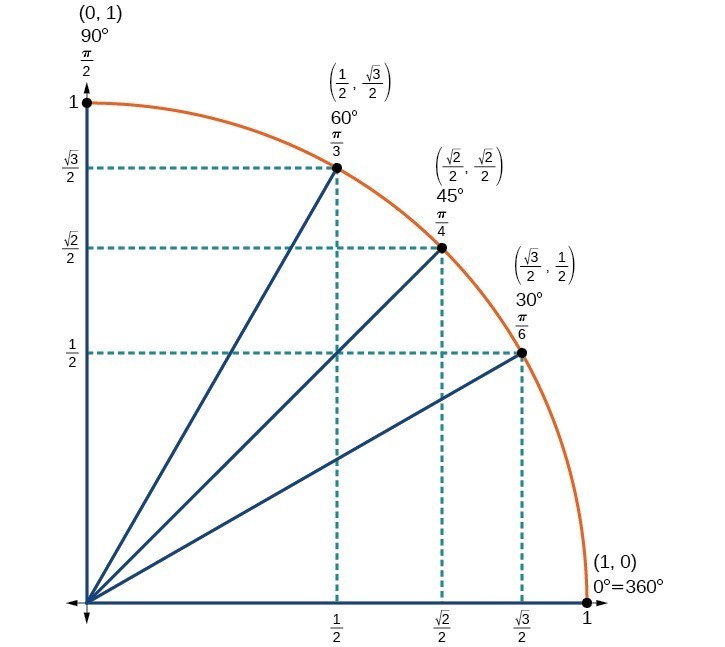
Figure fourteen
Using a Computer to Detect Sine and Cosine
To detect the cosine and sine of angles other than the special angles, nosotros turn to a reckoner or estimator. Exist aware: Most calculators tin can be set into "degree" or "radian" mode, which tells the figurer the units for the input value. When nosotros evaluate [latex]\cos \left(30\right)[/latex] on our calculator, information technology will evaluate it as the cosine of thirty degrees if the estimator is in degree mode, or the cosine of 30 radians if the reckoner is in radian mode.
How To: Given an angle in radians, use a graphing figurer to detect the cosine.
- If the calculator has degree mode and radian mode, set it to radian style.
- Press the COS primal.
- Enter the radian value of the angle and printing the shut-parentheses central ")".
- Printing ENTER.
Example 4: Using a Graphing Calculator to Observe Sine and Cosine
Evaluate [latex]\cos \left(\frac{five\pi }{iii}\right)\\[/latex] using a graphing calculator or computer.
Solution
Enter the following keystrokes:
COS (five × π ÷ iii ) ENTER
[latex]\cos \left(\frac{5\pi }{3}\right)=0.v\\[/latex]
Analysis of the Solution
We can find the cosine or sine of an angle in degrees straight on a calculator with degree way. For calculators or software that use merely radian manner, we tin can notice the sign of [latex]20^\circ [/latex], for example, by including the conversion gene to radians as part of the input:
SIN( 20 × π ÷ 180 ) ENTER
Effort Information technology 4
Evaluate [latex]\sin \left(\frac{\pi }{3}\correct)\\[/latex].
Solution
Identifying the Domain and Range of Sine and Cosine Functions
Now that we can find the sine and cosine of an angle, we need to talk over their domains and ranges. What are the domains of the sine and cosine functions? That is, what are the smallest and largest numbers that tin be inputs of the functions? Because angles smaller than 0 and angles larger than [latex]2\pi [/latex] can still exist graphed on the unit circle and take real values of [latex]ten,y[/latex], and [latex]r[/latex], there is no lower or upper limit to the angles that can be inputs to the sine and cosine functions. The input to the sine and cosine functions is the rotation from the positive ten-axis, and that may be whatsoever real number.
What are the ranges of the sine and cosine functions? What are the least and greatest possible values for their output? We can see the answers by examining the unit of measurement circle, as shown in Figure fifteen. The premises of the x-coordinate are [latex]\left[-1,i\right][/latex]. The bounds of the y-coordinate are also [latex]\left[-1,1\right][/latex]. Therefore, the range of both the sine and cosine functions is [latex]\left[-ane,1\right][/latex].
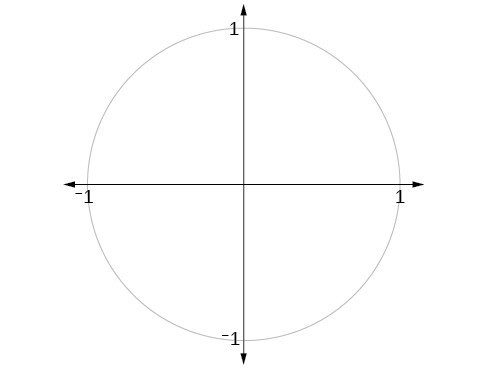
Figure 15
We have discussed finding the sine and cosine for angles in the first quadrant, but what if our bending is in another quadrant? For whatsoever given angle in the first quadrant, there is an bending in the second quadrant with the same sine value. Because the sine value is the y-coordinate on the unit circle, the other angle with the same sine will share the same y-value, but accept the opposite x-value. Therefore, its cosine value will be the opposite of the showtime angle'south cosine value.
Likewise, there will exist an angle in the fourth quadrant with the aforementioned cosine as the original bending. The angle with the aforementioned cosine volition share the aforementioned 10-value but will accept the contrary y-value. Therefore, its sine value will exist the opposite of the original angle's sine value.
Every bit shown in Effigy sixteen, angle [latex]\alpha [/latex] has the aforementioned sine value as angle [latex]t[/latex]; the cosine values are opposites. Angle [latex]\beta [/latex] has the same cosine value equally angle [latex]t[/latex]; the sine values are opposites.
[latex]\begin{array}{lll}\sin \left(t\right)=\sin \left(\alpha \right)\hfill & \text{and}\hfill & \cos \left(t\right)=-\cos \left(\blastoff \right)\hfill \\ \sin \left(t\right)=-\sin \left(\beta \correct)\hfill & \text{and}\hfill & \cos \left(t\right)=\cos \left(\beta \right)\hfill \end{array}[/latex]

Effigy sixteen
Recall that an bending's reference angle is the astute angle, [latex]t[/latex], formed by the last side of the angle [latex]t[/latex] and the horizontal axis. A reference bending is e'er an angle between [latex]0[/latex] and [latex]ninety^\circ [/latex], or [latex]0[/latex] and [latex]\frac{\pi }{2}[/latex] radians. Equally nosotros tin meet from Figure 17, for any angle in quadrants Two, III, or Four, at that place is a reference angle in quadrant I.
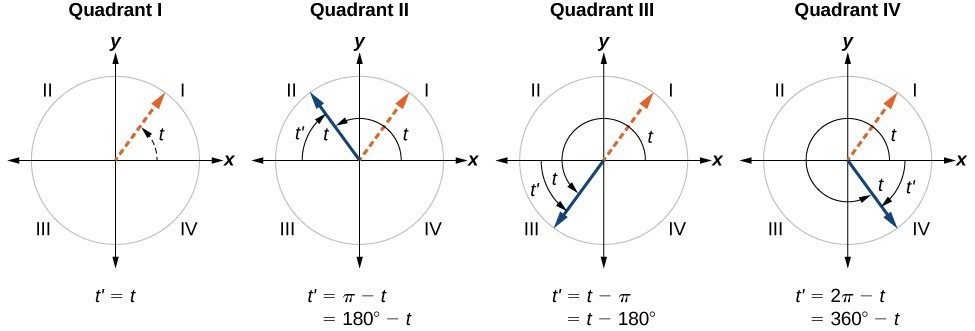
Figure 17
How To: Given an angle between [latex]0[/latex] and [latex]ii\pi [/latex], find its reference angle.
- An angle in the commencement quadrant is its own reference angle.
- For an angle in the second or tertiary quadrant, the reference angle is [latex]|\pi -t|[/latex] or [latex]|180^\circ \mathrm{-t}|[/latex].
- For an angle in the fourth quadrant, the reference angle is [latex]two\pi -t[/latex] or [latex]360^\circ \mathrm{-t}[/latex].
- If an angle is less than [latex]0[/latex] or greater than [latex]2\pi [/latex], add or subtract [latex]ii\pi [/latex] as many times as needed to find an equivalent bending betwixt [latex]0[/latex] and [latex]2\pi [/latex].
Example 5: Finding a Reference Bending
Find the reference angle of [latex]225^\circ [/latex] as shown in Figure 18.
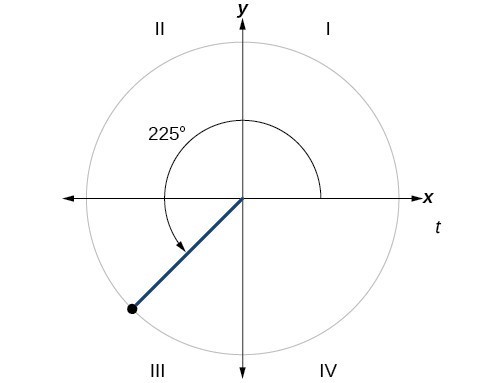
Figure xviii
Solution
Because [latex]225^\circ [/latex] is in the third quadrant, the reference angle is
[latex]|\left(180^\circ -225^\circ \right)|=|-45^\circ |=45^\circ [/latex]
Endeavor It 5
Detect the reference bending of [latex]\frac{5\pi }{3}[/latex].
Solution
Using Reference Angles
Now allow'southward take a moment to reconsider the Ferris wheel introduced at the beginning of this section. Suppose a passenger snaps a photograph while stopped 20 anxiety above ground level. The passenger then rotates three-quarters of the manner effectually the circle. What is the rider's new elevation? To respond questions such equally this one, we need to evaluate the sine or cosine functions at angles that are greater than ninety degrees or at a negative angle. Reference angles make it possible to evaluate trigonometric functions for angles outside the first quadrant. They can too be used to find [latex]\left(ten,y\right)[/latex] coordinates for those angles. We will use the reference bending of the bending of rotation combined with the quadrant in which the terminal side of the angle lies.
Using Reference Angles to Evaluate Trigonometric Functions
We can detect the cosine and sine of whatever angle in any quadrant if we know the cosine or sine of its reference angle. The absolute values of the cosine and sine of an angle are the same as those of the reference angle. The sign depends on the quadrant of the original angle. The cosine will exist positive or negative depending on the sign of the x-values in that quadrant. The sine will exist positive or negative depending on the sign of the y-values in that quadrant.
A General Notation: Using Reference Angles to Find Cosine and Sine
Angles have cosines and sines with the same absolute value as their reference angles. The sign (positive or negative) can be determined from the quadrant of the angle.
How To: Given an angle in standard position, find the reference bending, and the cosine and sine of the original angle.
- Measure the angle between the terminal side of the given bending and the horizontal centrality. That is the reference bending.
- Make up one's mind the values of the cosine and sine of the reference angle.
- Give the cosine the same sign equally the x-values in the quadrant of the original bending.
- Requite the sine the same sign every bit the y-values in the quadrant of the original bending.
Example 5: Using Reference Angles to Find Sine and Cosine
- Using a reference angle, observe the exact value of [latex]\cos \left(150^\circ \right)[/latex] and [latex]\text{sin}\left(150^\circ \correct)[/latex].
- Using the reference bending, find [latex]\cos \frac{v\pi }{iv}[/latex] and [latex]\sin \frac{5\pi }{4}[/latex].
Solution
- 150° is located in the second quadrant. The angle it makes with the x-axis is 180° − 150° = xxx°, and so the reference angle is 30°.This tells usa that 150° has the same sine and cosine values as 30°, except for the sign. We know that
[latex]\cos \left(30^\circ \right)=\frac{\sqrt{three}}{two}\text{and}\sin \left(30^\circ \right)=\frac{i}{2}[/latex].
Since 150° is in the 2nd quadrant, the x-coordinate of the point on the circle is negative, so the cosine value is negative. The y-coordinate is positive, so the sine value is positive.
[latex]\cos \left(150^\circ \right)=-\frac{\sqrt{iii}}{two}\text{and}\sin \left(150^\circ \correct)=\frac{i}{2}[/latex]
- [latex]\frac{v\pi }{4}[/latex] is in the 3rd quadrant. Its reference bending is [latex]\frac{5\pi }{four}-\pi =\frac{\pi }{iv}[/latex]. The cosine and sine of [latex]\frac{\pi }{four}[/latex] are both [latex]\frac{\sqrt{2}}{2}[/latex]. In the third quadrant, both [latex]x[/latex] and [latex]y[/latex] are negative, so:
[latex]\cos \frac{5\pi }{4}=-\frac{\sqrt{2}}{two}\text{and}\sin \frac{five\pi }{iv}=-\frac{\sqrt{2}}{2}[/latex]
Endeavour Information technology 6
a. Utilize the reference bending of [latex]315^\circ [/latex] to find [latex]\cos \left(315^\circ \right)[/latex] and [latex]\sin \left(315^\circ \right)[/latex].
b. Apply the reference bending of [latex]-\frac{\pi }{6}[/latex] to find [latex]\cos \left(-\frac{\pi }{6}\correct)[/latex] and [latex]\sin \left(-\frac{\pi }{six}\right)[/latex].
Using Reference Angles to Find Coordinates
At present that we have learned how to find the cosine and sine values for special angles in the get-go quadrant, we tin can use symmetry and reference angles to fill in cosine and sine values for the remainder of the special angles on the unit circle. They are shown in Figure 19. Have time to learn the [latex]\left(ten,y\right)[/latex] coordinates of all of the major angles in the first quadrant.

In addition to learning the values for special angles, we tin can use reference angles to find [latex]\left(x,y\right)[/latex] coordinates of any point on the unit circle, using what we know of reference angles along with the identities
[latex]\begin{assortment}{l}x=\cos t\hfill \\ y=\sin t\hfill \end{array}[/latex]
Start we notice the reference angle corresponding to the given angle. Then we take the sine and cosine values of the reference angle, and give them the signs respective to the y– and x-values of the quadrant.
How To: Given the angle of a signal on a circumvolve and the radius of the circumvolve, detect the [latex]\left(x,y\right)[/latex] coordinates of the point.
- Find the reference angle by measuring the smallest bending to the ten-axis.
- Discover the cosine and sine of the reference bending.
- Make up one's mind the appropriate signs for [latex]ten[/latex] and [latex]y[/latex]
in the given quadrant.
Instance 6: Using the Unit Circle to Find Coordinates
Find the coordinates of the point on the unit circle at an angle of [latex]\frac{seven\pi }{vi}[/latex].
Solution
Nosotros know that the angle [latex]\frac{seven\pi }{six}[/latex] is in the third quadrant.
First, let's observe the reference angle by measuring the bending to the 10-axis. To find the reference bending of an angle whose terminal side is in quadrant 3, we find the difference of the bending and [latex]\pi [/latex].
[latex]\frac{7\pi }{six}-\pi =\frac{\pi }{6}[/latex]
Next, we will find the cosine and sine of the reference angle:
[latex]\cos \left(\frac{\pi }{6}\correct)=\frac{\sqrt{3}}{2}\sin \left(\frac{\pi }{6}\right)=\frac{1}{2}[/latex]
We must determine the appropriate signs for x and y in the given quadrant. Because our original angle is in the third quadrant, where both [latex]10[/latex] and [latex]y[/latex] are negative, both cosine and sine are negative.
[latex]\begin{array}{50}\cos \left(\frac{7\pi }{six}\right)=-\frac{\sqrt{iii}}{2}\hfill \\ \sin \left(\frac{7\pi }{6}\right)=-\frac{ane}{2}\hfill \end{array}[/latex]
Now we can summate the [latex]\left(ten,y\right)[/latex] coordinates using the identities [latex]ten=\cos \theta [/latex] and [latex]y=\sin \theta [/latex].
The coordinates of the point are [latex]\left(-\frac{\sqrt{3}}{2},-\frac{one}{2}\right)[/latex] on the unit circle.
Effort It 7
Find the coordinates of the point on the unit circle at an angle of [latex]\frac{5\pi }{three}[/latex].
Solution
Primal Equations
| Cosine | [latex]\cos t=10[/latex] |
| Sine | [latex]\sin t=y[/latex] |
| Pythagorean Identity | [latex]{\cos }^{ii}t+{\sin }^{two}t=1[/latex] |
Cardinal Concepts
- Finding the function values for the sine and cosine begins with drawing a unit of measurement circle, which is centered at the origin and has a radius of 1 unit.
- Using the unit circle, the sine of an bending [latex]t[/latex] equals the y-value of the endpoint on the unit circle of an arc of length [latex]t[/latex] whereas the cosine of an angle [latex]t[/latex] equals the x-value of the endpoint.
- The sine and cosine values are well-nigh directly determined when the corresponding point on the unit circle falls on an axis.
- When the sine or cosine is known, we can utilise the Pythagorean Identity to find the other. The Pythagorean Identity is too useful for determining the sines and cosines of special angles.
- Calculators and graphing software are helpful for finding sines and cosines if the proper process for entering data is known.
- The domain of the sine and cosine functions is all real numbers.
- The range of both the sine and cosine functions is [latex]\left[-1,one\correct][/latex].
- The sine and cosine of an bending have the same accented value as the sine and cosine of its reference bending.
- The signs of the sine and cosine are adamant from the x– and y-values in the quadrant of the original angle.
- An angle's reference angle is the size angle, [latex]t[/latex],
formed by the terminal side of the angle [latex]t[/latex] and the horizontal centrality. - Reference angles can exist used to find the sine and cosine of the original angle.
- Reference angles can likewise exist used to observe the coordinates of a point on a circumvolve.
Glossary
- cosine office
- the x-value of the point on a unit of measurement circle corresponding to a given angle
- Pythagorean Identity
- a corollary of the Pythagorean Theorem stating that the square of the cosine of a given angle plus the square of the sine of that angle equals 1
- sine role
- the y-value of the point on a unit circle corresponding to a given bending
- unit circle
- a circumvolve with a center at [latex]\left(0,0\right)[/latex]
and radius
Section Exercises
- ane. Describe the unit circle.
- 2. What do the ten- and y-coordinates of the points on the unit circle represent?
three. Discuss the difference betwixt a coterminal angle and a reference bending.
4. Explain how the cosine of an angle in the 2d quadrant differs from the cosine of its reference angle in the unit circumvolve.
5. Explain how the sine of an angle in the second quadrant differs from the sine of its reference bending in the unit of measurement circle.
For the following exercises, employ the given sign of the sine and cosine functions to discover the quadrant in which the terminal point adamant by [latex]t[/latex] lies.
6. [latex]\text{sin}\left(t\right)<0[/latex] and [latex]\text{cos}\left(t\correct)<0[/latex]
7. [latex]\text{sin}\left(t\correct)>0[/latex] and [latex]\cos \left(t\correct)>0[/latex]
8. [latex]\sin \left(t\right)>0[/latex] and [latex]\cos \left(t\right)<0[/latex]
9. [latex]\sin \left(t\right)<0[/latex] and [latex]\cos \left(t\right)>0[/latex]
For the following exercises, observe the verbal value of each trigonometric function.
x. [latex]\sin \frac{\pi }{ii}[/latex]
11. [latex]\sin \frac{\pi }{3}[/latex]
12. [latex]\cos \frac{\pi }{two}[/latex]
13. [latex]\cos \frac{\pi }{3}[/latex]
14. [latex]\sin \frac{\pi }{4}[/latex]
xv. [latex]\cos \frac{\pi }{4}[/latex]
16. [latex]\sin \frac{\pi }{6}[/latex]
17. [latex]\sin \pi [/latex]
18. [latex]\sin \frac{3\pi }{two}[/latex]
xix. [latex]\cos \pi [/latex]
twenty. [latex]\cos 0[/latex]
21. [latex]\cos \frac{\pi }{6}[/latex]
22. [latex]\sin 0[/latex]
For the following exercises, state the reference angle for the given angle.
23. [latex]240^\circ [/latex]
24. [latex]-170^\circ [/latex]
25. [latex]100^\circ [/latex]
26. [latex]-315^\circ [/latex]
27. [latex]135^\circ [/latex]
28. [latex]\frac{five\pi }{four}[/latex]
29. [latex]\frac{two\pi }{three}[/latex]
30. [latex]\frac{5\pi }{6}[/latex]
31. [latex]\frac{-11\pi }{3}[/latex]
32. [latex]\frac{-7\pi }{iv}[/latex]
33. [latex]\frac{-\pi }{8}[/latex]
For the following exercises, find the reference angle, the quadrant of the terminal side, and the sine and cosine of each angle. If the angle is not one of the angles on the unit of measurement circle, employ a reckoner and round to three decimal places.
34. [latex]225^\circ [/latex]
35. [latex]300^\circ [/latex]
36. [latex]320^\circ [/latex]
37. [latex]135^\circ [/latex]
38. [latex]210^\circ [/latex]
39. [latex]120^\circ [/latex]
40. [latex]250^\circ [/latex]
41. [latex]150^\circ [/latex]
42. [latex]\frac{5\pi }{iv}[/latex]
43. [latex]\frac{7\pi }{6}[/latex]
44. [latex]\frac{five\pi }{3}[/latex]
45. [latex]\frac{3\pi }{iv}[/latex]
46. [latex]\frac{4\pi }{iii}[/latex]
47. [latex]\frac{ii\pi }{3}[/latex]
48. [latex]\frac{v\pi }{6}[/latex]
49. [latex]\frac{7\pi }{four}[/latex]
For the following exercises, find the requested value.
50. If [latex]\text{cos}\left(t\right)=\frac{1}{vii}[/latex] and [latex]t[/latex] is in the fourth quadrant, find [latex]\text{sin}\left(t\correct)[/latex].
51. If [latex]\text{cos}\left(t\right)=\frac{2}{9}[/latex] and [latex]t[/latex] is in the 1st quadrant, find [latex]\text{sin}\left(t\right)[/latex].
52. If [latex]\text{sin}\left(t\right)=\frac{three}{viii}[/latex] and [latex]t[/latex] is in the 2nd quadrant, notice [latex]\text{cos}\left(t\right)[/latex].
53. If [latex]\text{sin}\left(t\right)=-\frac{1}{four}[/latex] and [latex]t[/latex] is in the 3rd quadrant, find [latex]\text{cos}\left(t\correct)[/latex].
54. Observe the coordinates of the point on a circle with radius fifteen corresponding to an angle of [latex]220^\circ [/latex].
55. Observe the coordinates of the point on a circumvolve with radius 20 corresponding to an angle of [latex]120^\circ [/latex].
56. Find the coordinates of the point on a circle with radius viii respective to an angle of [latex]\frac{7\pi }{4}[/latex].
57. Observe the coordinates of the point on a circle with radius 16 corresponding to an bending of [latex]\frac{5\pi }{9}[/latex].
58. State the domain of the sine and cosine functions.
59. State the range of the sine and cosine functions.
For the post-obit exercises, use the given indicate on the unit circle to find the value of the sine and cosine of [latex]t[/latex].
sixty.
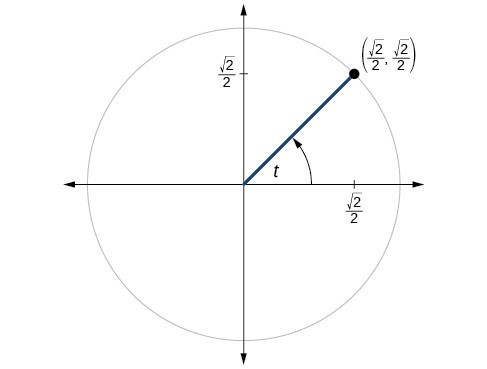
61.
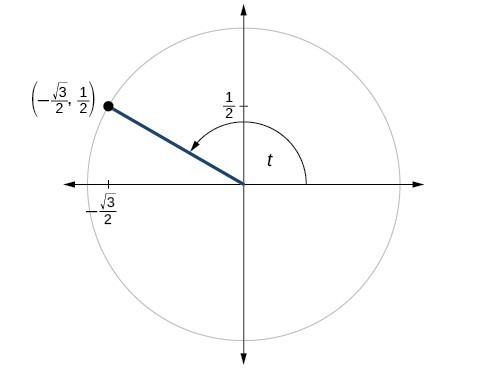
62.
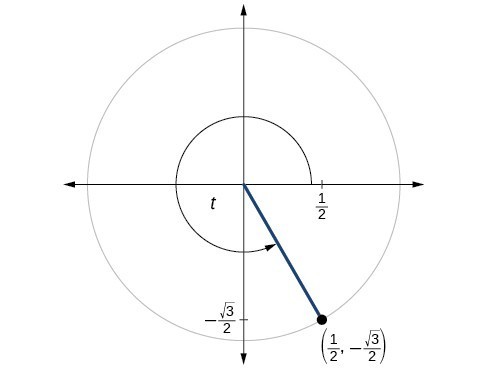
63.
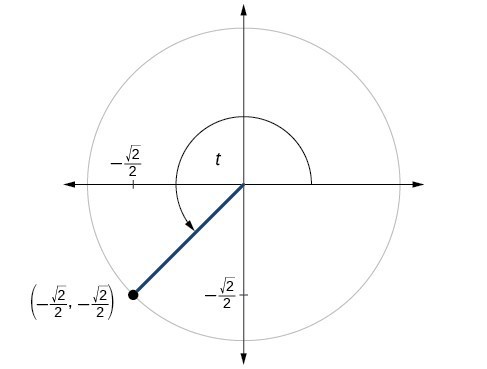
64.
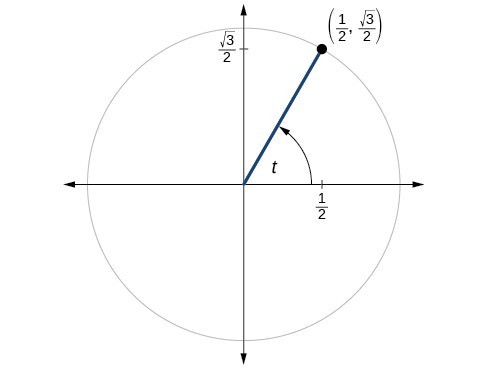
65.
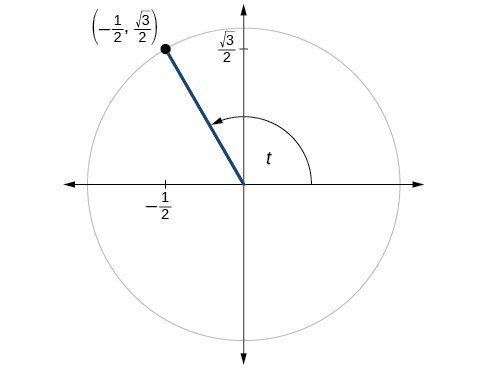
66.
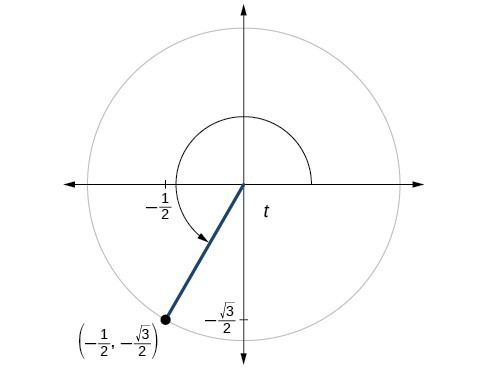
67.
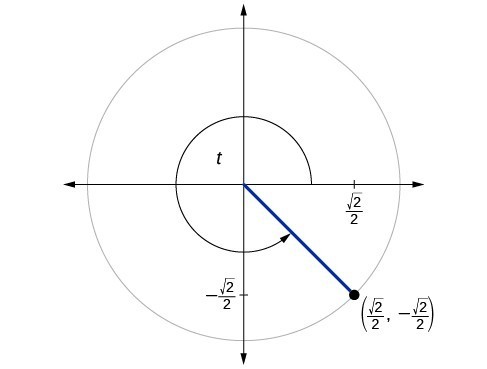
68.
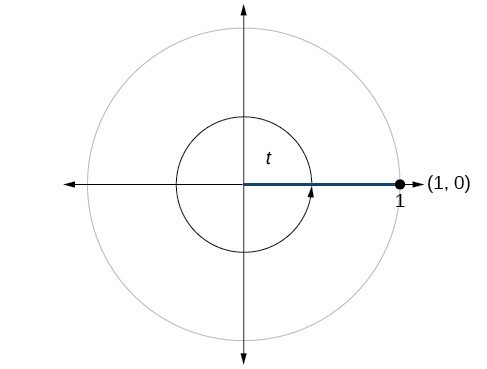
69.
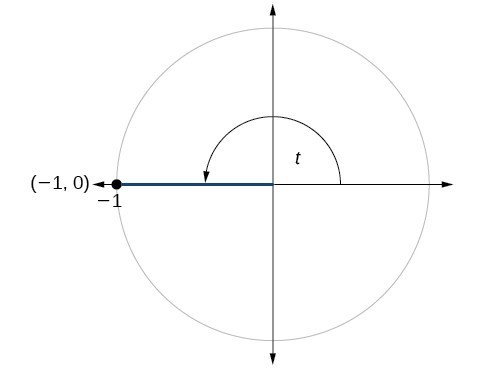
lxx.
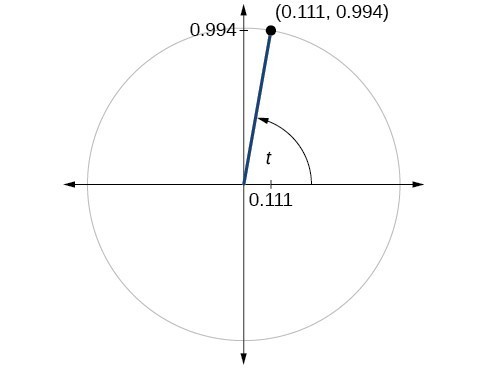
71.
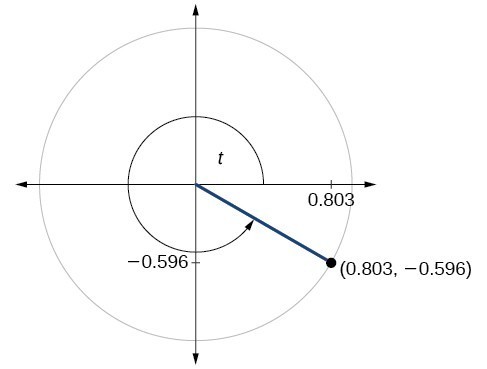
72.
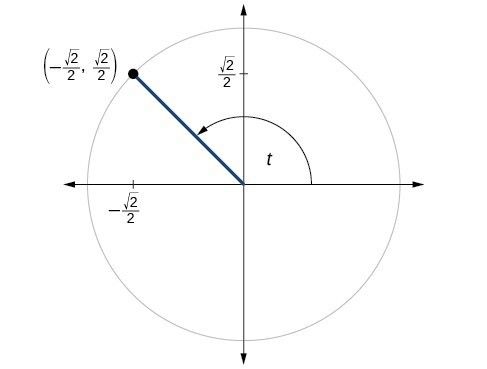
73.
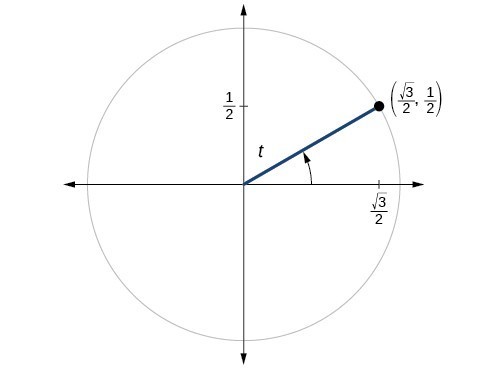
74.
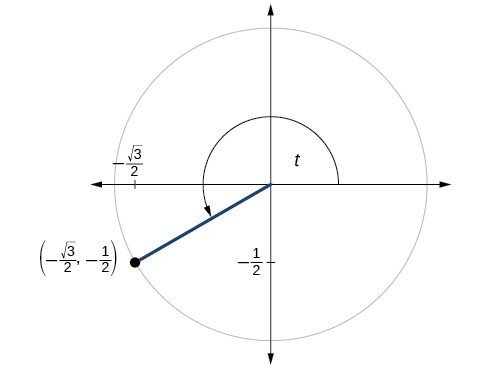
75.
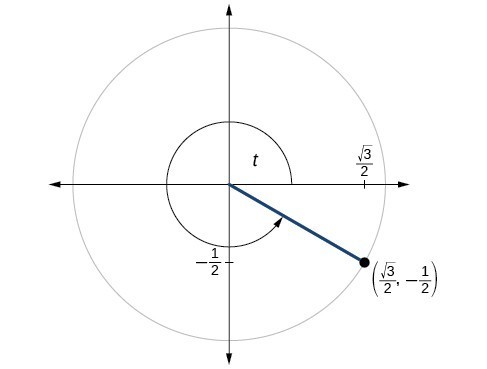
76.
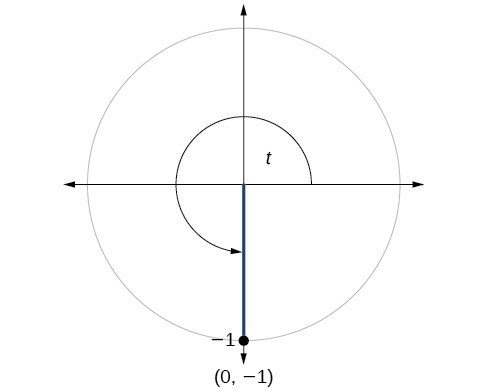
77.
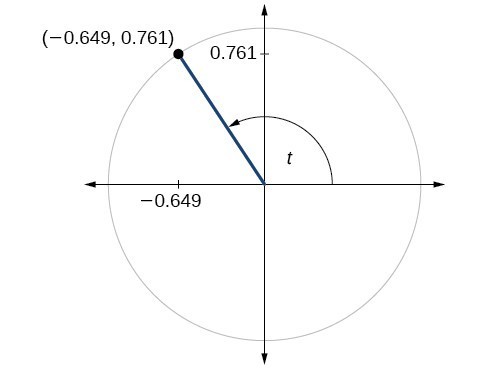
78.
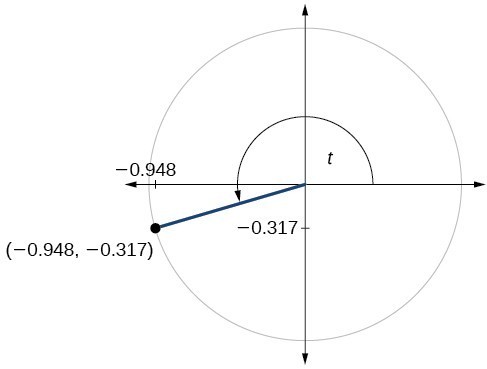
79.
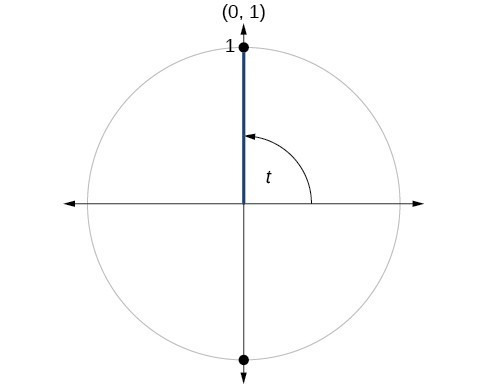
For the following exercises, use a graphing figurer to evaluate.fourscore. [latex]\sin \frac{5\pi }{9}[/latex]
81. [latex]\cos \frac{five\pi }{ix}[/latex]
82. [latex]\sin \frac{\pi }{10}[/latex]
83. [latex]\cos \frac{\pi }{x}[/latex]
84. [latex]\sin \frac{three\pi }{4}[/latex]
85. [latex]\cos \frac{3\pi }{4}[/latex]
86. [latex]\sin 98^\circ [/latex]
87. [latex]\cos 98^\circ [/latex]
88. [latex]\cos 310^\circ [/latex]
89. [latex]\sin 310^\circ [/latex]
90. [latex]\sin \left(\frac{11\pi }{3}\right)\cos \left(\frac{-5\pi }{6}\right)[/latex]
91. [latex]\sin \left(\frac{three\pi }{4}\right)\cos \left(\frac{v\pi }{3}\correct)[/latex]
92. [latex]\sin \left(-\frac{4\pi }{3}\right)\cos \left(\frac{\pi }{2}\right)[/latex]
93. [latex]\sin \left(\frac{-9\pi }{4}\correct)\cos \left(\frac{-\pi }{6}\right)[/latex]
94. [latex]\sin \left(\frac{\pi }{6}\right)\cos \left(\frac{-\pi }{3}\right)[/latex]
95. [latex]\sin \left(\frac{seven\pi }{four}\right)\cos \left(\frac{-2\pi }{three}\correct)[/latex]
96. [latex]\cos \left(\frac{5\pi }{6}\right)\cos \left(\frac{two\pi }{3}\correct)[/latex]
97. [latex]\cos \left(\frac{-\pi }{three}\right)\cos \left(\frac{\pi }{4}\right)[/latex]
98. [latex]\sin \left(\frac{-five\pi }{iv}\right)\sin \left(\frac{11\pi }{6}\right)[/latex]
99. [latex]\sin \left(\pi \right)\sin \left(\frac{\pi }{half dozen}\correct)[/latex]
For the post-obit exercises, use this scenario: A child enters a carousel that takes ane infinitesimal to revolve one time around. The child enters at the betoken [latex]\left(0,1\right)[/latex], that is, on the due north position. Assume the carousel revolves counter clockwise.
100. What are the coordinates of the child subsequently 45 seconds?
101. What are the coordinates of the child after 90 seconds?
102. What is the coordinates of the child afterwards 125 seconds?
103. When will the child have coordinates [latex]\left(0.707,-0.707\right)[/latex] if the ride lasts 6 minutes? (There are multiple answers.)
104. When volition the kid have coordinates [latex]\left(-0.866,-0.5\right)[/latex] if the ride last 6 minutes?

Source: https://courses.lumenlearning.com/precalctwo/chapter/unit-circle-sine-and-cosine-functions/
Posted by: scotttheatione.blogspot.com
0 Response to "How To Draw A Circle Usind Sin Function"
Post a Comment